NŪR: 30 Days of Praying for the Muslim World

The NEMA Ramadan Prayer Diary 2026 is here.

Another Ramadan begins.

Across Nigeria, over 100 million Muslims will start thirty days of fasting, prayer, and spiritual seeking. Before dawn, families will rise for suhoor. At sunset, they will gather for iftar. Mosques will be full. Hearts will be open. And a single question will quietly drive the entire month: “Will God accept me?”

We believe the Church has something to do in this season — and it starts with prayer.

This is our third year walking this road together.
In 2024, we released SHAFĀ’AT — the Arabic word for intercession. That year, we prayed through selected Nigerian cities, lifting up specific places by name and asking God to move in each one. In 2025, we went deeper with BEYOND THE CRESCENT — learning and praying through Islamic doctrines and beliefs, equipping the Church to understand the faith of our Muslim neighbours and to intercede with knowledge.

This year, the Lord laid something simpler and more profound on our hearts: NŪR — Light. Each year, the journey has grown. From cities, to doctrine, to the very nature of God Himself. We’re not just praying louder, we’re praying deeper.

Why “Nūr”?
Nūr is one of the most beautiful words in the Muslim world. Parents name their children after it — Nūrudeen, Munīrah, Anwar. The Qur’an calls God the Light of the heavens and the earth. The longing for light is already there.

And Jesus said simply: “I am the light of the world.” That’s where this year’s prayer bulletin resonates, at the intersection of that longing and that promise.

What’s Inside
Thirty days. Five movements. One journey of light.

The Spark — praying for Muslim hearts to encounter God personally
The Flame — praying for families, women, youth, children, and leaders
The Lamp — praying for new believers, discipleship, and the Church’s role
The Dawn — praying for unreached peoples, cities, conflict zones, and new access
The Blaze — praying for workers, tools, and a generation rising to carry the light forward

Each day includes a Scripture, a window into Islamic life and belief, a Gospel reflection, and prayer points — all written with warmth, respect, and genuine love for the people we’re called to reach.

A Remarkable Moment
Here’s something worth pausing over.
This year, Ramadan and Lent begin on the same day. Two of the world’s largest faith communities will enter seasons of fasting, prayer, and spiritual hunger simultaneously. Muslims crying out for guidance. Christians seeking God’s face. On the same day. At the same time.

That’s not coincidence. That’s an invitation.
What might God do when so many hearts are open at once? We want to be part of finding out.

Who Is This For?
You. Your church. Your prayer group. Your campus fellowship. Your family devotion time. Whether you live next to a mosque in Kano or worship in a church in Enugu, this diary will help you pray with knowledge, compassion, and faith.

The Light shines in the darkness. And the darkness has not overcome it.

Download Your Free Copy
DOWNLOAD NŪR — RAMADAN PRAYER DIARY 2026 (PDF)

Use it. Share it. Send it to your pastor, your WhatsApp group, your campus fellowship. Let no one pray alone this Ramadan.

May this guide also help you pray with deeper understanding and greater love, until every people, every nation, and every generation encounters the Light of Christ.

NEMA HarvestScope 3.0: A Strategic Window into the State of the Harvest in Nigeria

The Nigeria Evangelical Missions Association (NEMA) is pleased to announce the release of HarvestScope 3.0 (2025) — the third and most comprehensive edition of Nigeria’s national missions research report.

HarvestScope exists to provide the Nigerian Church, mission agencies, partners, and stakeholders with reliable, field-informed data on the state of the harvest in Nigeria. This edition reflects months of rigorous research, data verification, and engagement with NEMA member agencies and mission leaders across the country.

What Is HarvestScope?
HarvestScope is NEMA’s flagship research and reporting initiative, designed to:

  • Track the state of the Great Commission in Nigeria
  • Highlight unreached and least evangelised people groups
  • Provide insight into missionary deployment and engagement patterns
  • Inform strategic planning, prayer, mobilisation, and collaboration

HarvestScope 3.0 builds on previous editions with updated data, deeper analysis, and expanded thematic focus.

What Does HarvestScope 3.0 Cover?
This edition is organised into seven key sections:

Section A: Organisational Profile and the State of the Harvest in Nigeria
An overview of Nigeria’s missions landscape, organisational capacity, and overall progress.

Section B: Unreached and Cross-Cultural Engagement
An updated profile of Nigeria’s unreached and least evangelised people groups and mission engagement among them.

Section C: Urban and Diaspora Missions
Insights into urban ministry, internal migration, and Nigerian missionary presence among diaspora communities.

Section D: Leadership Landscape
Findings on leadership structures, tenure systems, and succession realities across mission organisations.

Section E: Workforce Realities and Missionary Well-being
Data on missionary deployment, care systems, sustainability, and field challenges.

Section F: Needs Assessment and Missional Opportunities
Identified gaps, priority needs, and emerging opportunities for strategic mission investment.

Section G: Digital Engagement and Organisational Visibility
An analysis of how mission organisations are using digital platforms for communication, mobilisation, and impact.

Why HarvestScope 3.0 Matters
HarvestScope 3.0 is more than a report, it is a strategic tool for:

  • Church leaders and mission executives shaping future directions
  • Mission agencies strengthening structures and care systems
  • Mobilisers and trainers equipping the next generation
  • Intercessors and partners praying with informed understanding
  • Donors and supporters investing with clarity and confidence

The report reflects the collective efforts, sacrifices, and testimonies of God’s work through Nigerian missions, while also honestly identifying gaps that require prayer, innovation, and collaboration.

Access the Report
HarvestScope 3.0 is available for free download here:
Download HarvestScope 3.0
Printed copies are also available at the NEMA Bookshop.

Partner with Us
If you have updates, corrections, or additional information about any people groups or mission engagements, or if you would like to:
– Enquire about the report,
– Adopt any of the tribes or issues highlighted for engagement,
– Partner with NEMA on research, mobilisation, or missions strategy,

please contact the Directorate of Monitoring, Evaluation, Learning and Research (MELR) at:
📧 melr@nemanigeriamissions.org

Together, as the Body of Christ, we can steward the harvest more faithfully and effectively for God’s glory and the fulfillment of the Great Commission.

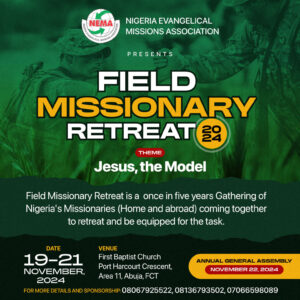
Field Missionary Retreat 2024: Jesus, the Model

“Whatever you do, work at it with all your heart, as working for the Lord, not for human masters, since you know that you will receive an inheritance from the Lord as a reward. It is the Lord Christ you are serving.” Colossians 3:23-24 (NIV)

 The Field Missionary Retreat is upon us again. It is a once-in-five-years gathering that promises to be a time of rest, renewal, and re-equipping for our collective mission task. As we journey through the challenges and triumphs of missionary work, Field Missionary Retreat provides a vital opportunity to step back, recharge, and refocus on the mission to which God has called us.

As missionaries, irrespective of our cadre and engagement, our lives and ministries are deeply rooted in the example set by Jesus Christ. He is our ultimate model in every aspect—our work, our service, and our devotion. In light of this, the theme for the Field Missionary Retreat 2024, “Jesus, the Model,” calls us to reflect on how we can align our lives more closely with His example.

This year’s retreat is designed not only to provide rest but also to equip missionaries with resources they need to face the evolving challenges of the mission field. Participants will benefit from a wide range of Bible studies, group discussions and networking, all aimed at strengthening their ministry efforts. We encourage every mission leader to see that their missionaries, are part of this year’s gathering. It will be a moment to pause and reflect, to be renewed in spirit, and to gain fresh vision for the work that lies ahead.

Mark Your Calendar:
Date: November 19 – 21, 2024
Venue: First Baptist Church, Garki, Area 11, FCT Abuja
Registration Link: https://fmr24.nemanigeriamissions.org

The gathering is completely free for all participants. However, if you feel led to make a difference, you can sponsor a missionary for just ₦20,000. This sponsorship helps cover the subsidised costs of accommodation, meals, and other resources. Material resources like new clothes, shoes, books and study materials, ministry tools and equipment, personal care items, non-perishable food items, etc, can also be given. These can be sent to our zonal offices or the NEMA headquarters in Jos. Check out the sponsorship page on the registration portal for more information.

Ramadan Prayer Diary: Day 30, 9th April, 2024

The Ramadan Moon sets, but the Harvest continues. Will you join the harvest force?

As the golden crescent moon dips below the horizon, marking the end of Ramadan, a different kind of light shines brightly – the light of opportunities. This Holy Month has been a time of reflection and spiritual growth for our Muslim cousins, and as Christians, we see a chance to sow seeds of understanding and perhaps, even witness the harvest of faith.

Many Muslims are more open to spiritual conversations after Ramadan. Their hearts are softened by prayer and focused on their connection to God. This presents a unique opportunity for us to build bridges of friendship and share the love of Christ.

The harvest is plentiful and God is still actively recruiting men for the harvest of the nation, most importantly among muslims. Consider the abundance of souls waiting to hear the life-transforming message of Christ, waiting to experience the freedom found in His love. The fields are ripe with hearts ready to receive the good news of salvation. Will you be one of the labourers, willing to join the mighty harvest force that God is assembling for this crucial season?

Will you commit to being a labourer in this abundant harvest?

Here are three simple steps you can take:

  1. Pray: Continue to fervently pray for our Muslims. Pray for divine encounters, softened hearts, and the revelation of Christ’s love to permeate their lives.
  2. Build Relationships: Actively engage with your Muslim neighbours, co-workers, or friends. Building genuine relationships creates a bridge for the love of Christ to flow naturally.
  3. Share Your Testimony: Your personal journey with Christ is a powerful testimony. Share it with others, including your Muslim friends, and let them witness the transformation that can occur through a relationship with Jesus.

Please pray:

  • Thank the Lord for the success of this year’s Ramadan and this prayer initiative.
  • Pray that God will spur your heart to be involved in the harvest of Muslims around you.
  • Ask God for grace to live right and model Christ to your Muslim neighbours.
  • Ask for open doors for you to take your Muslim friends on the journey of discovering more about Jesus.

Ramadan Prayer Diary: Day 29, 8th April, 2024

Muslim students on Campus

“Whatever happens, conduct yourselves in a manner worthy of the gospel of Christ. Then, whether I come and see you or only hear about you in my absence, I will know that you stand firm in the one Spirit, striving together as one for the faith of the gospel.” Philippians 1:27 NIV

Several years ago, Kabir enrolled in one of the prestigious tertiary institutions in his region. Raised in a predominantly Muslim community, he had minimal exposure to other faiths, leading to a lack of tolerance for beliefs outside of what he is familiar with. However, during his first year at university, Kabir lived in the same room with some Christian students whose lifestyle and discussions gradually influenced him.

Despite initial resistance, Kabir became increasingly open to learning about Christ and engaged in discussions with his friends on the topics of true religion and salvation. By the time he approached his final year, Kabir experienced a significant change in perspective, ultimately deciding to follow Christ and share the gospel with his family and friends upon returning home.

Today, there are numerous individuals like Kabir who encounter opportunities to explore Christianity through interactions with Christian students at various tertiary institutions. While some embrace this opportunity and make life-changing decisions, others remain unchanged or even grow more resistant to the message of Christianity.

Please Pray:

  • Thank God for the many who are coming to know and trust in Jesus Christ on campuses across the world.
  • That God will open doors to share the gospel to Muslim students on campus and Muslim Background Believers leaders will be raised from our campuses.
  • That Muslim students will be more open and receptive to the gospel.

Ramadan Prayer Diary: Day 28, 7th April, 2024

Saki, Nigeria

Violence shall no more be heard in thy land, wasting nor destruction within thy borders; but thou shalt call thy walls Salvation and thy gates Praise.” Isaiah 60:18, KJV

The journey from Ibadan to Saki made us pass through many fascinating scenery and landscapes. Sights of rural dwellers intersecting with emerging urban features caught our attention. “We are there now”, said our tour guide after sighting the Asabari Barracks. We were welcomed with the beautiful speaking of the Yoruba language with the Onko dialect, popular among the Okeogun people of the northern part of Oyo State The giant hand-held iron pot greeted us at the city centre. “This is a very remarkable symbol of the popular trade of the Saki people”, he added. Saki is on a strategic route linking Southern Nigeria to the North on the western border of the country with the Republic of Benin. Rich in history, Saki is believed to have been a temporary seat of government of the Yoruba kingdom. There is also a strong affiliation of Ogun (the Yoruba god of iron) to Saki.

Being a border town, Saki receives thousands of peoples on daily basis. Trade and commerce is a normal life in the city. Smuggling is not uncommon; a major feature of border cities. It was time for Maghrib prayer. The blast from the horn speakers drove thousands into nearby Mosques. “Our people are very religious. They believe in the teachings of the Prophet and in the Holy Book”, said a local Imam. Islam thrives in the city though Christian missionary effort has been in the city since early 19th century. Saki hosts a high significant number of Muslims. Very unlikely of Southwest Nigeria, where adherents of different faiths cohabit without frequent clashes, Saki witnessed a major religious riot in 2000 resulting in loss of lives and properties as well as destruction of worship centers. The town has not been the same since then.

Please Pray:

  • Thank the Lord for the seed of the gospel which has been sown in Saki many years ago. Ask the Lord to make gospel effort to prosper especially among Muslims in the town.
  • Pray that Christians in Saki will live as light and salt thereby making the Gospel real to those who are yet to accept the Good News.
  • Pray that the Light will shine in the heart of every seeker in the town and particularly among those who are genuinely seeking the Way.

Ramadan Prayer Diary: Day 27, 6th April, 2024

Laylatul Qadr– Night of Power

“You will seek me and fine me, when you seek me with all your heart.” Jeremiah 29:13 NIV

Laylat al-Qadr is a period whereby the Muslims believe that Allah sent the entire Holy Quran down from the seventh heaven to the first heaven. It is also known as the Night of Power where Muslims seek to be close and connected to God through dreams, and visions. This they do by spending additional time in prayer at the mosque believing that angels descend to earth with multiple tasks, leading to a night of peace, blessings, and divine guidance.

Although they are not sure which night this was, most Muslims believe that it was sent down during one of the last ten nights of Ramadan. However, Shia Muslims observe it on the 23rd night of Ramadan while the Sunni Muslims observe it on the 27th night of Ramadan.

It is believed to be the night in which heaven is opened and God responds to prayer in a way unlike any other night of the year as such they involve themselves in charity, strive hard to earn the pleasure of Allah and seek his forgiveness. Muslims believe that night is more spiritually blessed than a thousand months.

Please pray

  • Ask that God’s mercy and wisdom be poured out abundantly on this night, bringing clarity and purpose to the hearts of those earnestly seeking Him.
  • Pray that the desire for peace, blessings, and divine connection will draw Muslims into a closer relationship with the Lord, leading to a lasting impact on their spiritual journey.
  • Pray for a revelation of the person of Jesus for everyone who waits and search this day. Ask that their hearts be flooded with light and stirred towards the truth which sets free.

Ramadan Prayer Diary: Day 26, 5th April, 2024

Hadejia, Nigeria

The righteous will flourish like the date palm. They will grow like a cedar in Lebanon.” Psalm 92:12

The date palms are so big and fresh. They taste different from the ones sold in the central part of the country. “Our land, though in the Savannah, is blessed by God. The wetland that stretches into the neighbouring state is simply an oasis in the desert. We grow cotton, millet, sorghum, rice, groundnuts just to mention a few. We also engage in fishing activities. God has His imprint in this land. I think He did so, so that from beholding His handiwork, the people might embrace Him.” Those were the words of an indigenous missionary as we exited Hadejia for our next destination.

A town rich in history, Hadejia previously known as Biram, is considered as one of the seven true Hausa states (Hausa Bakwai). It is believed to have been ruled by one of the descendants of Bayajidda. The latter is revered as the father of the Hausa race. It became a Fulani emirate after its conquest in the 1810 war. Yet, Hadejia resisted British occupation in 1906.

Islam is the prominent religion among the indigenous people in the commercial town.  Many numbering over a million and resident in the town daily pray to be shown the perfect way which the righteous are graciously shown. Will you passionately pray today that their heart-cry be granted by Him who is the Way, the Truth and the Light.

Please Pray:

  • Pray that as resident of Hadejia behold the splendour of nature and the yield of their harvest, their hearts will be drawn to the Master Designer.
  • Pray that the Lord will send into Hadejia, gospel labourers who are divinely equipped to multiply obedient disciples.
  • Ask the Lord to break every resistance to the Truth and that every veil be removed.

Ramadan Prayer Diary: Day 25, 4th April, 2024

Sokoto, Sokoto State

And we know that the Son of God has come and has given us understanding, so that we may know him who is true; and we are in him who is true, in his Son Jesus Christ. He is the true God and eternal life.1 John 5:20 ESV

Situated in the far northwest region of the country, as of 2005, this state boasts an estimated population exceeding 4.2 million. Being the nucleus of the former Sokoto Caliphate, the city predominantly follows the Islamic faith and serves as a pivotal center for Islamic education within Nigeria. The Sultan, who leads the caliphate, assumes the role of spiritual guide for Nigerian Muslims.

During the 19th century, under the reign of the Fulani Empire, Sokoto emerged as a significant Fula state and urban center within what was then west central Nigeria. Enclosed by the arid Sahel, with sandy savannah and solitary hills encompassing it, Sokoto endures soaring temperatures, particularly from February to April, when daytime highs can surpass 45 °C (113.0 °F).

Although European colonists abolished the political authority of the caliphate, the title of sultan was retained and remains an important religious position for Sunni Muslims in the city to the current day. The Sokoto jihad, initiated by Usman dan Fodio, served as inspiration for similar movements across the Sudanian Savanna and the Sahel, establishing Islamic states in present-day Senegal, Mali, Ivory Coast, Chad, the Central African Republic, and Sudan.

Sokoto holds so much religious significance for the Muslims as they have diverse historical antecedents.

Please Pray:

  • That the heart of the indigenous people will be open to the gospel, beginning from the leaders.
  • That there will be an emergence of church planting movements in the Caliphate.
  • That God will raise spirit-filled labourers for the work in this city, people who won’t give up till God’s glory burst forth in the city and it environs.

Ramadan Prayer Diary: Day 24, 3rd April, 2024

Almajiri in Nigeria

They wander about for food and growl if they are not satisfied.” Psalm 59:15

He dipped his right hand into the pink plastic bowl. Then, he fetched some palm-oiled concotioned rice, tilted his head slightly backwards to allow his hand drop the meal into his mouth. He noticed that I was watching. He smiled releasing some droplets of the red oil on his jaws. The friendly eye contact drew me closer. His trousers were of unequal length and a different shade from the V-neck top. I guess the original colour must have been white, it is now looking palish brown.

“I am fourteen years old. My mother has eight of us for my father who has eleven other children from two other wives. I am the fifteenth of the nineteenth children. My mother enrolled me in the Quranic school when I was four. The Malam teaches us from the holy book though we do more of memorising it. To survive daily, we are sent into the streets where we fend for ourselves by appealing to kind hearted people to give us money. But our main need is just food; so we often go around restaurants hoping to have something to eat.” Sani said looking helpless. It is obvious he would have preferred a better life if only he knows how to arrive at it.

Such is the fate of about eight million mostly male children and teens and popularly found on the streets in most northern cities and towns in Nigeria. They are popularly referred to as Almajiri, an Hausa word derived from the Arabic word Al-muhajir meaning someone who migrates from his home in search of Islamic education. They are under the tutelage of an Islamic teacher (Malam). When not engaged in learning, they are found on the streets usually begging or roaming around in search of food. Religious extremists find them easily accessible and available to use for their ulterior motives.

Please Pray

  • Ask the Lord to show forth His mercies on many trapped in the Almajiri system.
  • Pray for divine encounters for the boys as they roam about in search of livelihood.
  • Beseech the Lord to bring hope and grace unto these ones and that their lot may not be destroyed.